Mirza Saeed Akhtar
The Satanic VersesMirza Saeed Akhtar is the skeptical zamindar whose love for his dying wife draws him into Ayesha’s pilgrimage from Titlipur to the Arabian Sea. He travels alongside a march he considers irrational, trying to stop it even as he cannot abandon Mishal or the people who follow her. His olive-green Mercedes-Benz becomes a conspicuous counterpoint to their foot journey: a vehicle of modern comfort following a crowd committed to a supernatural promise. At the pilgrimage’s end, the people enter the sea and disappear, while Saeed’s recollection offers an uncertain, intimate account of what happened beneath the water.
Identity and marriage
On his fortieth birthday, Saeed wakes before dawn in the mansion he shares with Mishal. A recurring dream of the world’s end has left him troubled; the previous night he had been reading Nietzsche on humanity’s possible extinction. But in the shadowy bedroom, among butterflies stirring around the sleeping Mishal, affection overtakes that anxiety. Their marriage began as an arranged match: Mishal’s father was a state-bank director, and the alliance restored the fortunes of Saeed’s old, decaying family. Though the couple have had no children, the marriage has ripened into genuine love.
The tenderness of this opening is sharpened by what Saeed does not yet know. He watches Mishal sleep and takes comfort in her presence, while the illness that will soon define their remaining time together is already present in her body. His birthday’s apparent domestic stillness thus introduces a private bond that will be tested not by a single argument, but by grief, competing beliefs, and the question of what it means to stay beside someone whose convictions he cannot share.
Saeed’s attachment to Mishal is mixed with self-reproach. He has persuaded her to take the veil, and her mother’s criticism brings back doubts about his own motives. Reading Tagore’s Ghare-Baire, in which a zamindar encourages his wife to leave purdah and her new independence becomes entangled with politics and danger, Saeed wonders whether his stated reasons for Mishal’s seclusion were sincere or whether he wanted the way clear to pursue Ayesha. His attraction to Ayesha is therefore not detached from his marriage: it feeds his suspicion of himself and makes his care for Mishal harder to separate from jealousy and guilt.
Ayesha, Mishal, and the command
Saeed becomes increasingly unsettled when he learns that Mishal spends much of her time with Ayesha, the village girl known for making small enamel animals and selling them by the Grand Trunk Road. Ayesha has had epilepsy since childhood, and Mishal’s knowledge of the villagers’ lives gives her a closeness to them that Saeed cannot match. He has difficulty recognizing more than a few villagers, while his wife knows their histories and dreams. At first, the sight of the two women together seems only another occasion for his fondness for Mishal. It soon becomes a source of jealousy: Mishal grows reticent, and Saeed cannot tell whether he resents Ayesha’s influence over his wife or the intimacy between them.
Ayesha tells Mishal that she has received word from the archangel Gibreel that Mishal is dying of cancer. The disease, located in Mishal’s breasts, makes the prospect of death especially cruel to a woman who had hoped to nurse a child. Ayesha urges her to regard her illness as a test of faith and promises that God will save her. For Saeed, this revelation joins a report of imminent death to a claim of divine reassurance, neither of which he can accept as knowledge. Yet Mishal’s faith begins to bind her more closely to Ayesha precisely as her illness advances.
The pilgrimage command turns private divisions into a public rupture. Before the village panchayat, Ayesha announces that she has flown with Gibreel to the highest heights and brought back a message that requires everything of the people and promises that everything will be given. The panchayat votes unanimously to obey. When plans are made to build litters so that older and infirm villagers can ride, the Sarpanch’s wife insists that the command requires walking; only the youngest infants are to be carried. The preparation of the village is not an abstract act of belief for Saeed: it means homes and fields left behind, a difficult journey undertaken by people he regards as vulnerable, and Mishal preparing to go with them.
He bursts in on Mishal as the packing gathers pace, imagining political agitators or bribery behind what he sees as collective folly. But no offer of money can resolve the conflict. When Saeed breaks down, Mishal embraces him from behind. He consents to her departure and offers the Mercedes station wagon, air-conditioning, and an icebox of soft drinks. His compromise is both practical and revealing: he cannot grant the miracle, but he tries to make the journey survivable. He then decides to accompany the pilgrims while still disbelieving, determined to challenge the undertaking at every step.
The march and its human cost
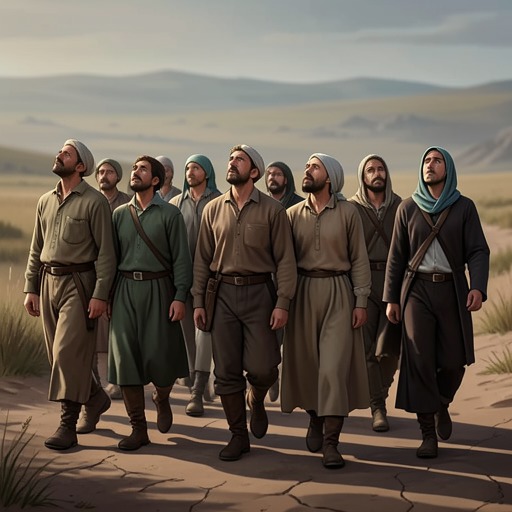
Saeed follows the walkers in the olive-green Mercedes, sometimes bringing up the rear beneath the butterflies that accompany Ayesha. The police mistake the pilgrimage for a sectarian demonstration. Saeed explains that the villagers mean to walk to the Arabian Sea because they believe its waters will part, while making clear that he is not one of the believers and intends to change their minds. His intervention briefly draws in Srinivas, a Brahmin who has never contemplated a pilgrimage to Mecca. Saeed appeals to what they regard as modern knowledge: old people die on long journeys, cancer is not cured by God, and oceans do not divide. He offers Srinivas a place in the car and asks for help in persuading Ayesha.
The route crosses a country in which water is becoming scarce. Bony cattle search for drink; families travel south with their belongings on dying donkeys, hoping to find water. A slogan painted on a scooter factory wall gives the scarcity a stark emotional form, while Saeed points out that the sea the pilgrims seek is salt water. He sees a contradiction between people struggling to survive and a march that, in his view, may lead them to death. The road does not confirm the safety of either position: drought makes their need real, but it does not make the promised parting of the sea more credible to him.
The pilgrims make slow progress, walking three hours in the morning and three more after the heat, at the pace of the slowest among them. Children fall sick, authorities harass the group, and a bullock-cart wheel comes off. They manage at best two miles a day over the 150 miles to the sea, a journey expected to take about eleven weeks. On the eighteenth day, Khadija, the long-married wife of Sarpanch Muhammad Din, dies after dreaming of Gibreel. Her death is the first of several losses that put pressure on the community’s belief and on Saeed’s decision to remain with the march.
Muhammad Din, unwilling to abandon the undertaking for which his wife has died but no longer able to sustain absolute belief, shifts toward Saeed’s skepticism. Saeed welcomes him as his first convert. Meanwhile, Ayesha imposes stricter discipline: the pilgrims must perform all five daily prayers, and Fridays become days of fasting. By the end of the sixth week, four more people have died—two old men, an old woman, and a six-year-old girl. The marchers continue, leaving the bodies behind; Saeed, with Muhammad Din and Osman, gathers them and ensures that they receive proper burials. Their work takes them behind the group, but the Mercedes catches up with the more than 140 women, men, and children walking toward the sea. Saeed’s skepticism is no longer only an argument against belief; it has become care for the dead whom the pilgrimage leaves in its wake.
Growing divisions and the final approach
After eight weeks, Saeed and Mishal are no longer speaking. Her cancer has made her ashen, but she has become Ayesha’s chief lieutenant and most devoted disciple. The doubts spreading among other marchers strengthen Mishal’s own conviction, and she blames her husband for those doubts. They now occupy opposite positions within the same procession: Mishal’s faith intensifies in the face of death, while Saeed’s concern for her makes it harder for him simply to leave.
By the ninth week, the story has spread throughout the country. Journalists, politicians seeking votes, businesses hoping to advertise on the marchers, foreign tourists, Gandhians, and spectators drawn to possible disaster converge on the pilgrimage. The butterflies, which cover Ayesha and provide her with solid food, unsettle visitors’ expectations of what they are seeing. Public attention does not settle the question of whether the miracle is real; it makes the march an object of competing interpretations. Saeed remains among those trying to stop it, rather than becoming a believer because others have come to watch.
During floods, Saeed and a small group stand in water in a town intersection. The villagers they had followed are no longer visible, and he tells Ayesha that the pilgrimage is finished: they may be drowned, murdered, or lost, and nobody remains to follow her except the small group with him. His certainty is directed at the practical evidence before him, but it cannot undo the journey or the losses already incurred. Later, in the mosque, he challenges the way Ayesha conveys Gibreel’s message. She offers interpretations rather than the angel’s precise words, Saeed observes, and he demands to know why she does not simply quote. His challenge recalls an earlier question in the book about whether revelation comes from outside the prophet or from an inward act of listening. Here that uncertainty becomes a problem of authority: the followers must trust Ayesha’s account of a message they cannot hear directly.
The sea and Saeed’s unresolved ending
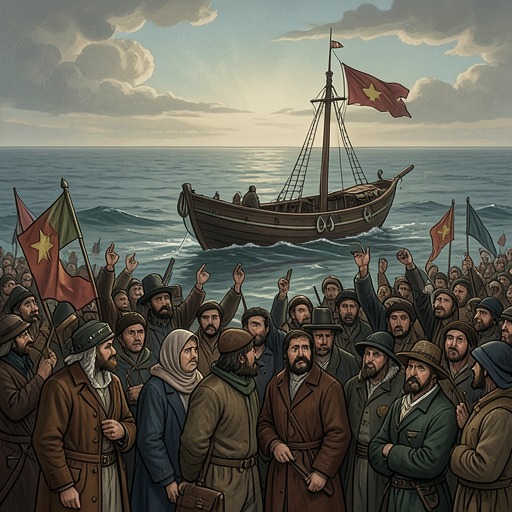
The pilgrimage reaches the coast at high tide. Its passage into the city and onto the beach carries it through crowded urban spaces and accumulated refuse before the walkers arrive at the sand. The sea is not the empty, abstract destination of Saeed’s arguments; it is a physical presence at the end of a long march, and the choice facing the pilgrims is now immediate. Ayesha, Mishal, and the villagers go into the water and sink below sea level. None is seen again.
Afterward, officers from the Criminal Investigation Department ask Saeed what he saw at the beach. His account does not give a stable resolution. He recalls butterflies struggling to enter his mouth, the sea pouring over him, and Ayesha appearing beside him as though she had emerged from Mishal’s body. Beneath the water, he hears her call for him to open, as though the journey still requires a final act of submission. He closes instead. The account can be read as a vision shaped by grief, as a supernatural encounter, or as an unstable memory; the narrative does not make Saeed’s testimony an uncomplicated proof for either skepticism or faith.
His refusal completes, without resolving, his conflict. Saeed has walked beside the believers, surrendered the use of his car to their journey, tried to prevent their deaths, and buried those who died along the road. At the shore, however, he does not follow Mishal and Ayesha into the sea. His attachment has brought him to the threshold of their belief without making him able to share it. The unanswered question of what he witnessed preserves the story’s tension between modern explanations and religious certainty, while the image of Saeed closing himself against Ayesha’s call leaves his love, doubt, and loss bound together.